 celldiagram.world
Biology · Comparison
Plant vs Animal Cell Diagram
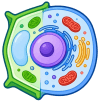
Two labeled cell diagrams side by side, with a Venn diagram view for the classic 'differences and similarities' question. Click any structure in either cell to read what it does.
Plant cell
Animal cell
Tap an organelle
What does it do?
Click any part of the diagram — even with the labels switched off — to read its name and function here.
Fixed vector diagram, drawn and checked against standard biology curricula — not AI-generated on the fly.
Plant vs animal cell: the differences at a glance
| Feature | Plant cell | Animal cell |
|---|---|---|
| Cell wall | Present, made of cellulose | Absent |
| Overall shape | Fixed and box-like | Round or irregular |
| Chloroplasts | Present in cells exposed to light | Absent |
| Vacuole | One large permanent central vacuole | Small, temporary, often several |
| Energy source | Photosynthesis, plus respiration | Respiration only; food is taken in |
| Lysosomes | Rare | Common |
| Centrioles | Absent in most plants | Present |
| Stored carbohydrate | Starch | Glycogen |
The three differences that matter most
If a question asks for the differences between a plant and an animal cell, three answers will nearly always earn the marks. Plant cells have a rigid cellulose cell wall, animal cells do not. Plant cells have chloroplasts and can photosynthesise, animal cells cannot. And plant cells have one large permanent central vacuole, while animal cells have only small temporary ones.
Two more differences are worth adding at higher levels: animal cells have centrioles and many lysosomes, and the two cell types store carbohydrate differently — starch in plants, glycogen in animals.
What both cells share
Both are eukaryotic, so both keep their DNA inside a nucleus and both are wrapped in a partially permeable cell membrane. Both contain cytoplasm, mitochondria, ribosomes, endoplasmic reticulum and a Golgi apparatus, and both use respiration to release energy as ATP.
That shared list is exactly what belongs in the overlapping middle section of a Venn diagram of a plant and an animal cell — a common source of lost marks, because students often leave the intersection nearly empty.
How to draw the comparison in an exam
For a table, write the feature in the first column and one row per difference, never a paragraph. For a Venn diagram, put structures unique to plants on the left, structures unique to animals on the right, and everything both cells contain in the overlap — at least four or five items.
If you are asked for a labeled drawing instead, draw the plant cell with straight edges and a double outline for the wall and membrane, and the animal cell with a single soft, irregular outline. That one visual detail immediately shows which cell is which.
Test Yourself
Three quick questions. No sign-up, no score saved anywhere.
Question 1 of 4 · Score 0
Which structure is found in plant cells but not animal cells?
Frequently Asked Questions
What is a Venn diagram of a plant and animal cell?
A two-circle diagram: structures found only in plant cells on one side, only in animal cells on the other, and shared structures such as the nucleus, mitochondria and ribosomes in the overlap.
What are the three main differences between plant and animal cells?
Plant cells have a cellulose cell wall, chloroplasts and one large central vacuole. Animal cells have none of these three.
What do plant and animal cells have in common?
Both are eukaryotic and both contain a cell membrane, cytoplasm, a nucleus, mitochondria, ribosomes, endoplasmic reticulum and a Golgi apparatus.
Which cell is bigger, a plant cell or an animal cell?
Plant cells are usually larger, often 10-100 micrometres against roughly 10-30 for a typical animal cell, mostly because of the central vacuole. Diagrams are not drawn to scale.
Do animal cells have chloroplasts?
No. Animal cells cannot photosynthesise, so they have no chloroplasts and must obtain glucose from food.