 celldiagram.world
Biology · Cell Structure
Plant Cell Diagram
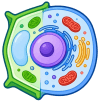
A labeled plant cell diagram, kept simple enough for a first biology class but accurate enough for exam revision. Click the cell wall, chloroplasts or central vacuole to see what each one does, or hide the labels and test yourself.
Skip to the diagramFixed vector diagram, drawn and checked against standard biology curricula — not AI-generated on the fly.
Cell Parts and Their Functions
| Structure | Function |
|---|---|
| Rigid outer layer that supports and protects the cell | |
| Controls what moves in and out of the cell | |
| Stores DNA and controls cell activity | |
| Stores water and sap, and keeps the cell firm | |
| Carries out photosynthesis using chlorophyll | |
| Releases energy (ATP) from glucose | |
| Builds and transports proteins and lipids | |
| Packages proteins and cell wall materials | |
| Builds proteins from amino acids |
Click a row to highlight that structure on the diagram.
What makes a plant cell look different
A plant cell is a eukaryotic cell with three structures an animal cell never has: a cell wall, chloroplasts and one large permanent central vacuole. Those three features are also what give it the familiar box-like outline in every diagram of a plant cell — the rigid cellulose wall holds the shape, so plant cells stack neatly like bricks in a tissue.
Inside the wall sits the cell membrane, and inside that the cytoplasm holds the nucleus, mitochondria, ribosomes, endoplasmic reticulum and Golgi apparatus. In a mature cell the vacuole is so large that it pushes the nucleus and the other organelles into a thin layer around the edge.
Cell wall, vacuole and chloroplast in detail
The cell wall is fully permeable and mainly structural: it supports the plant and stops the cell bursting when water enters by osmosis. Do not confuse it with the cell membrane just inside it, which is partially permeable and actually controls what gets in.
The central vacuole stores water, sugars, salts and waste. Water pressure inside it — turgor pressure — pushes out against the wall and keeps stems and leaves firm; when it drops, the plant wilts. Chloroplasts contain chlorophyll, which absorbs light energy so the cell can convert carbon dioxide and water into glucose in photosynthesis.
Why plant cells still need mitochondria
A very common misconception is that plants respire only at night, or that chloroplasts replace mitochondria. Plant cells contain both. Photosynthesis in the chloroplasts stores energy as glucose; respiration in the mitochondria releases that energy again as ATP, and it happens every hour of the day.
That is also why root cells, which never see light, have no chloroplasts but plenty of mitochondria — a good exam answer to remember when you are asked why not every plant cell looks like this diagram.
Test Yourself
Three quick questions. No sign-up, no score saved anywhere.
Question 1 of 4 · Score 0
Which structure gives a plant cell its rigid, box-like shape?
Frequently Asked Questions
What are the labeled parts of a plant cell?
Cell wall, cell membrane, cytoplasm, nucleus with nucleolus, large central vacuole, chloroplasts, mitochondria, ribosomes, endoplasmic reticulum and Golgi apparatus.
What is the difference between the cell wall and the cell membrane?
The cell wall is a rigid cellulose layer outside the membrane that gives support and is fully permeable. The cell membrane is thin, flexible and partially permeable, and controls what enters the cell.
Why do plant cells have a large central vacuole?
It stores water and dissolved substances, and the pressure it creates against the cell wall keeps the cell rigid so stems and leaves stay upright.
Do all plant cells have chloroplasts?
No. Only cells that are exposed to light, such as leaf cells, contain them. Root cells have none because there is no light underground.
Can I download a simple blank plant cell diagram?
Yes. Switch to Blank and use Download PNG for an unlabeled version you can print as a worksheet, free and without signing up.